
What is Wastewater Treatment?
Wastewater treatment is the process of removing physical, chemical, and biological contaminants from water generated during industrial, commercial, or domestic activities — before it is discharged into the environment or reused within operations.
In industrial contexts — particularly textile, garment, dyeing, and manufacturing — wastewater contains complex pollutants that cannot be released untreated without causing severe environmental and regulatory consequences.
Types of Wastewater
| TYPE | SOURCE | PRIMARY CONTAMINANTS |
| Process Effluent | Dyeing, washing, finishing | Dyes, chemicals, heavy metals, pH imbalance |
| Domestic Sewage | Toilets, kitchens, facility use | Organic matter, pathogens, nutrients |
| Cooling Water | Machinery and heat exchange | Heat, biocides, dissolved minerals |
| Boiler Blowdown | Steam generation systems | High TDS, hardness, dissolved solids |
| Stormwater Runoff | Rainwater from industrial sites | Suspended solids, hydrocarbons, sediment |
| Chemical Washwater | Equipment and floor cleaning | Solvents, surfactants, acids, alkalis |
Why is Wastewater Treatment Needed?
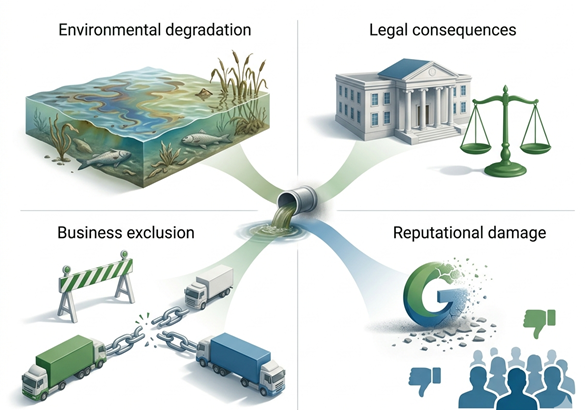
Untreated industrial wastewater contains pollutants that are toxic to aquatic life, contaminate groundwater sources, and cause long-term environmental degradation. Beyond environmental damage, non-compliance with discharge regulations results in legal penalties, operational shutdowns, and loss of export eligibility
| ENVIRONMENTAL DRIVERS Protect rivers, lakes, and groundwaterPrevent toxic bioaccumulation in food chainsReduce soil contamination riskEnable water reuse in water-scarce regions | REGULATORY DRIVERS National discharge standards and permitsEU REACH and industrial emission directivesBuyer ESG and ZDHC requirementsZero Discharge of Hazardous Chemicals (ZDHC) |
What is Sludge — and Why Does it Require Treatment?
Sludge is the semi-solid residual material produced during the physical, chemical, and biological treatment of wastewater. It contains concentrated contaminants removed from the water — including heavy metals, organic matter, chemical compounds, and microbial biomass.
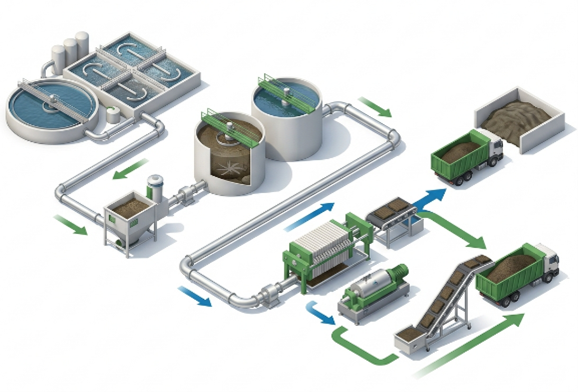
| TYPES OF SLUDGE Primary sludge — from physical settlingSecondary (biological) sludge — from biological treatmentChemical sludge from coagulation/flocculationMixed sludge — combined from multiple stages | WHY SLUDGE MUST BE TREATED Contains hazardous and toxic compoundsHigh moisture content requires volume reductionUnmanaged sludge causes secondary pollutionImproper disposal violates environmental law |
Sludge Treatment Process
- Thickening — Gravity or mechanical separation reduces water content and total volume
- Digestion — Anaerobic or aerobic biological treatment breaks down organic compounds
- Dewatering — Filter presses or centrifuges reduce moisture to 70-80% removal
- Drying — Thermal or solar drying further reduces mass and pathogen levels
- Final disposal — Landfill, incineration, co-processing, or agricultural reuse (if certified safe)
Regulatory obligation:
In most jurisdictions, industrial sludge is classified as hazardous waste. Its generation, storage, transportation, and disposal must be documented, tracked, and reported to environmental authorities. Failure to manage sludge correctly is treated as a separate compliance violation from wastewater discharge
ETP vs STP — Understanding the Difference
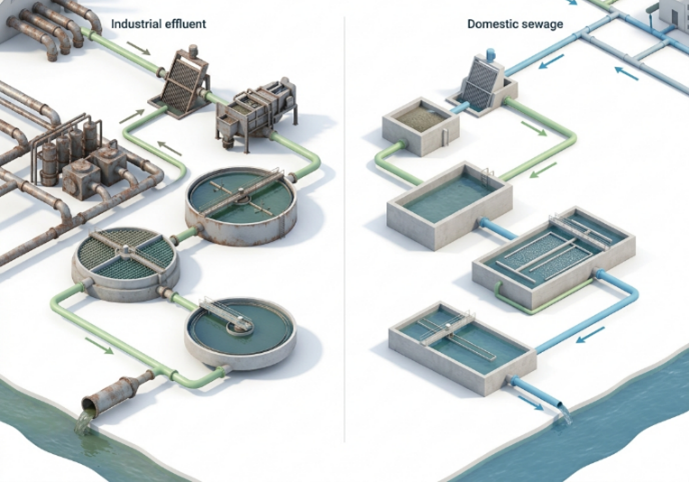
| ETP — EFFLUENT TREATMENT PLANT Designed to treat industrial process effluent — contaminated water generated directly from manufacturing and chemical processing operations. Handles dyes, chemicals, heavy metalsMulti-stage physical and chemical treatmentBiological oxidation for organic compoundsRequired for textile, leather, pharma, food industriesOutput: treated effluent for discharge or reuse | STP — SEWAGE TREATMENT PLANT Designed to treat domestic sewage and sanitary wastewater generated from human activities within a facility or community. Handles organic matter, nutrients, pathogensPrimary, secondary, and tertiary biological treatmentDisinfection stage for pathogen removalRequired for residential, commercial, and industrial facilitiesOutput: treated water suitable for reuse or safe discharge |
Critical distinction:
In large industrial facilities, both ETP and STP systems are required simultaneously — industrial process effluent and domestic sewage must not be combined and treated together, as their contaminant profiles and required treatment chemistries are fundamentally different.
ETP Treatment Stages
- Preliminary treatment — Screening and equalization to remove large solids and stabilize flow
- Primary treatment — Coagulation, flocculation, and sedimentation to remove suspended solids
- Secondary treatment — Biological oxidation using activated sludge or other biological processes
- Tertiary treatment — Advanced filtration, carbon adsorption, or membrane systems for residual contaminants
- Disinfection — UV, ozone, or chlorination to neutralize pathogenic organisms
- Sludge handling — Separation, dewatering, and regulated disposal of treatment residuals
Who Needs Wastewater Treatment Systems?
Treatment obligations extend across industries, supply chain tiers, and facility types
| INDUSTRIAL FACILITIES | SUPPLY CHAIN | REGULATED ENTITIES |
| Textile dyeing and finishing | Tier 1 and Tier 2 suppliers | Industrial estates and zones |
| Garment washing operations | Wet processing contractors | Export processing zones |
| Leather and tannery units | Chemical input producers | Large commercial complexes |
| Pharmaceutical manufacturers | Export-oriented manufacturers | Residential townships |
Where are Wastewater Regulations Applied?
Wastewater treatment requirements are enforced at national, regional, and international levels — with increasing alignment between domestic regulations and global buyer standards.
| REGION / FRAMEWORK | REGULATION | SCOPE |
| European Union | Industrial Emissions Directive (IED) | Discharge limits for large industrial installations |
| Global Supply Chain | ZDHC Wastewater Guidelines | Chemical and discharge standards for textile suppliers |
| South & Southeast Asia | National effluent standards (DOE, CPCB, BEPZA) | Mandatory ETP for export-oriented industries |
| International Finance | IFC Performance Standards | Wastewater compliance required for project financing |
| Brand Requirements | Buyer ESG and Restricted Substance Lists | ETP verification mandatory for approved supplier status |
When Should Treatment Systems Be Implemented?
ETP and STP systems are not future considerations. They are present-day operational and legal requirements for any industrial facility generating process or domestic wastewater. Delays in implementation increase compliance risk, audit failure rates, and buyer rejection.
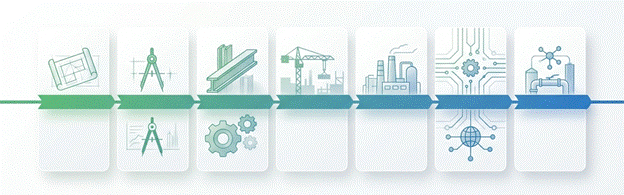
| TRIGGER EVENTS FOR IMPLEMENTATION New facility construction or expansionBuyer or brand audit requirementNational regulatory notice or inspectionESG disclosure or financing requirementsZDHC or GOTS certification application | TYPICAL IMPLEMENTATION TIMEFRAMES Feasibility assessment — 4 to 8 weeksSystem design and engineering — 8 to 16 weeksConstruction and installation — 12 to 24 weeksCommissioning and testing — 4 to 8 weeksTotal: 6 to 14 months end-to-end |
Recommended approach:
Companies should begin wastewater treatment planning at the earliest stage of facility development or expansion — not in response to regulatory notice. Retroactive system installation in operational facilities is significantly costlier and disruptive than integrated planning from the start.
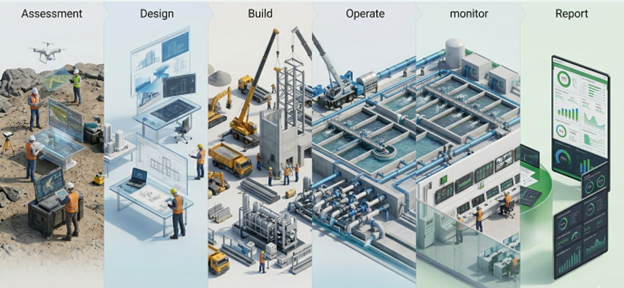
How is a Wastewater Treatment System Designed and Implemented?
- Wastewater Characterization
Collect and analyze wastewater samples to determine contaminant profile, flow rates, BOD, COD, TSS, pH, heavy metals, and chemical composition. This defines the treatment system requirements.
- Regulatory Discharge Standard Review
Identify applicable national and international discharge limits. Align system design targets with legal requirements and buyer-specific standards such as ZDHC Wastewater Guidelines.
- System Design and Engineering
Select appropriate treatment technologies based on wastewater composition. Design physical, chemical, and biological treatment stages. Integrate sludge handling and disposal systems into the overall design.
- Construction and Installation
Civil construction of treatment infrastructure, installation of tanks, equipment, and instrumentation. Include automation, monitoring sensors, and data logging systems from the start.
- Commissioning and Performance Testing
Operate the system under real process conditions. Conduct effluent quality testing across all parameters. Adjust chemical dosing, residence times, and biological loading to achieve discharge standards.
- Operator Training and Certification
Train facility operators on system operation, chemical handling, monitoring procedures, and emergency response. Certify competency for regulatory and audit requirements.
- Ongoing Monitoring and Compliance Reporting
Operate continuous or periodic effluent monitoring. Maintain discharge logs, sludge disposal records, and compliance documentation. Submit regulatory reports on the required schedule.
Challenges in Wastewater Treatment Implementation
Organizations across textile and manufacturing sectors commonly encounter the following obstacles:
- Variable effluent quality due to seasonal production changes and shifting chemical inputs
- High capital and operating costs for advanced treatment technologies
- Limited technical expertise for system operation and maintenance
- Sludge disposal constraints in regions without certified hazardous waste facilities
- Inadequate space for system installation in established facilities
- Lack of real-time monitoring and data management integration
These challenges require structured feasibility analysis, phased implementation planning, and expert technical guidance from initial design through operational maturity.
How SATIC Supports Wastewater Treatment & Environmental Compliance
End-to-end technical and advisory support across the full treatment lifecycle
| Wastewater Characterization & Testing | ETP and STP System Design |
| Discharge Standard Compliance Review | ZDHC Wastewater Compliance Support |
| Sludge Management System Design | Treatment Technology Selection |
| Operator Training & Certification | Continuous Monitoring System Integration |
| ESG and Environmental Reporting | Third-Party Audit Preparation |